








FALSTAFF
In a week of two Shakespeare comedies for me, Glyndebourne’s revival of their wittily shifted in time of Falstaff, Verdi’s version of The Merry Wives Of Windsor, could not have sat better. Shifting the time to 1946, a year after World War II had come to a close is a poignant reminder that in those years the emancipation of modern women was about to start. The decimation of the British male population, the empowering, to a certain extent, of women who would take on roles previously not available to them, had shifted societal norms.
In The Merry Wives Of Windsor the bard gave women the power to assert a level of strength in a tale of sexism and revenge that was surely way ahead of its time. After all, when written, women were not allowed to play female roles on the stage. Gender politics back at the time of Elizabeth I, an era when our country was ruled by a powerful woman.
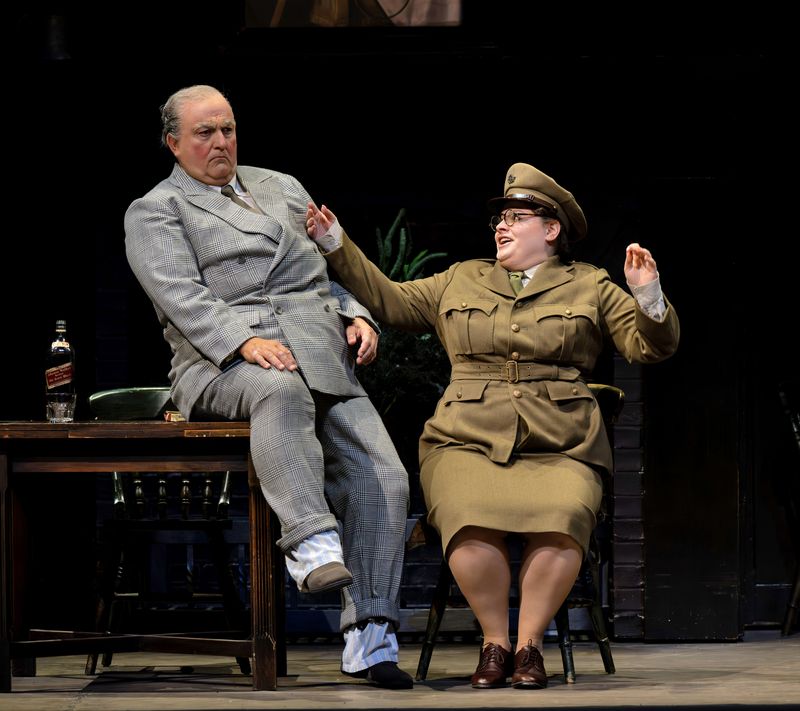
Renato Girolami & Valentina Pernozzoli © Glyndebourne Productions Ltd. Photo: Bill Knight
Verdi’s delivery of Sir John is hilarious, a sexist and arrogant buffoon who genuinely believes in his own sense of masculine prowess and sexual attraction. In reality he is an overweight glutton, booze addled and delusional. It’s a gift of a role and a gift that baritone Renato Girolami brings to life with pompous arrogance and a deliciously unpleasant air of sleaziness. In his bulging double breasted suit, bursting at the seams, one could not fail to be reminded of the great Barry Humphries creation Sir Les Patterson, an equally repugnant and deluded sexual monster. And how many men like that are we seeing revealed in modern times? Far too many for sure.
© Glyndebourne Productions Ltd. Photo: Bill Knight
All this gives the whole a very poignant contemporary relevance. Those merry wives could be crying “me too”, and they perfectly get the better of him.
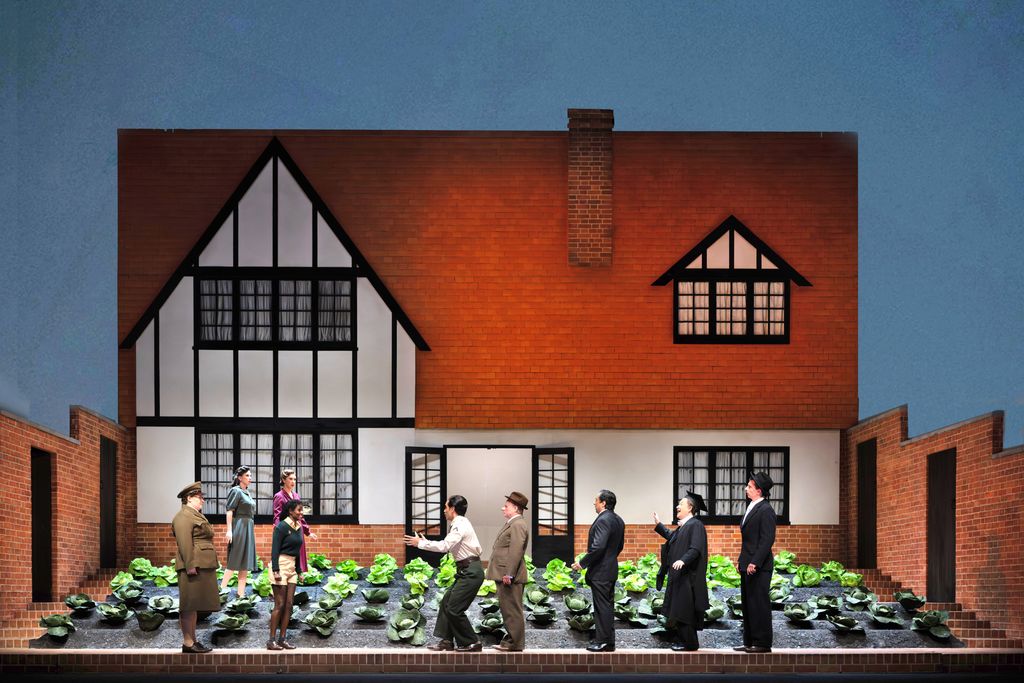
Shifting the setting to post war Britain gives a charming opportunity too to use that re-emergence of the half timbered architecture that became known as Tudor-Bethan, Sir John is holed up in the real thing, a period inn, whilst down the road the wives occupy the very thing in state of the art mid-century architecture.
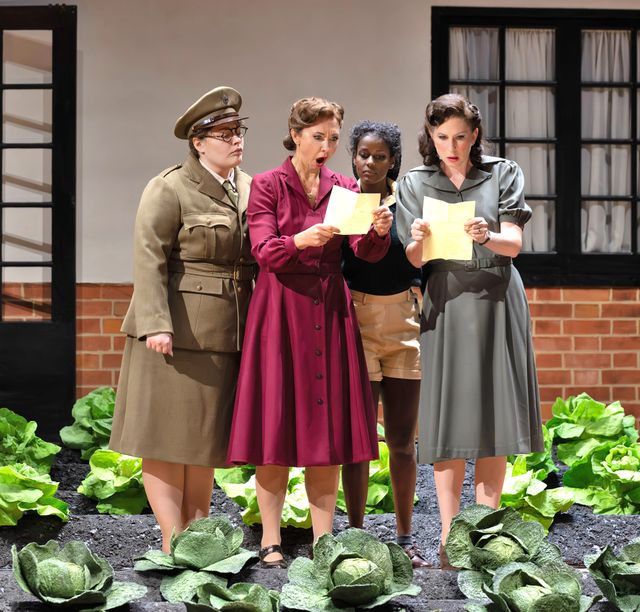
The wives, Anna Princeva as Alice Ford and Stephanie Lauricella as Meg Page are delightfully prim and proper on the surface, but when faced with Sir John’s impertinent and improper suggestions are fired up and bent on revenge. Mariam Battistelli is delightful in the role of Nanette, her fine soprano voice ringing out with bell-like clarity amongst the chaos of the action. And the action is certainly frantic with lots of precise physical comedy and trickery.
Mistress Quickly in this production is a marvellous invention that reeks of Ealing comedic charm with a dash of Carry On Sargeant to boot.Valentina Pernozzoli was simply scene-stealingly marvellous, genuine comedy skills combined with a fine and powerful mezzo-soprano voice.
© Glyndebourne Productions Ltd. Photo: Bill Knight
The clarity of the set by Ultz had the charm of a period comic strip, sharply drawn and uncluttered, even in the final scene at the blasted oak where the dark simplicity gave rein to a feast of comical fancy dressed characters as Sir John gets his comeuppance.
And what is not to love about simple conceits like uniformed Brownies stitching the tapestry of Windsor Castle, really delightful.
The whole is properly directed as comedy throughout by Richard Jones but never at the expense of some fine singing as one expects from a Glyndebourne production.
Andrew Kay
19 July
Glyndebourne
Rating: