







KÁŤA KABANOVÁ
The slow reveal from darkness of the stark white setting against the haunting strains of the overture showed so much promise. The slice of a stark white interior, a modernist white sofa, possibly not visible to those seated to the far left of the audience, setting the whole in a timeless space. But before long that stark and glaring white became a strain on the eyes. And that harsh white glaring light was ever present, occasionally surrounded by shifting colours, unexplained.
The whole was indicative of a production that was larded with symbolism, of Káťa’s state of mind, of the oppressive circumstances of her world and her thoughts. Hence the appearance of the bloodied angel and the huge boulder (the shape of which actually in that cage looked rather like a huge dead owl) and of course the first of those impressive black birdcages. It was strikingly beautiful of course, but that stylish beauty was perhaps the triumph of design over function, or indeed necessity. And how strange it felt that such minimalism could so clutter the tragic story of a women trapped by circumstance.
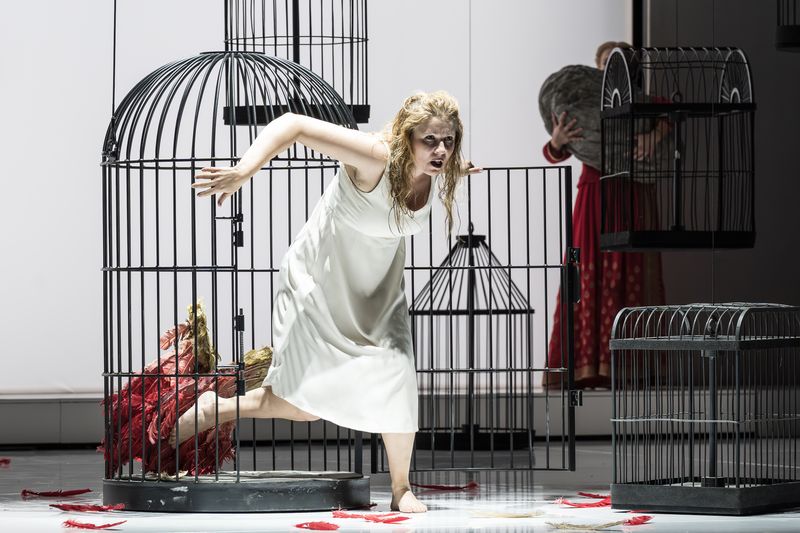
© Glyndebourne Productions Ltd. Photo: Marc Brenner
All this of course was easily dismissed, partly by closing my eyes, when listening to such beautiful music and stunning singing. The eponymous Káťa played by Kateřina Kněžíková is startlingly impressive, the voice more than impressive, precision matched by colour, acting the role so movingly and believably. I was glad that I had for the most part kept my eyes open to enjoy such an exquisite performance.
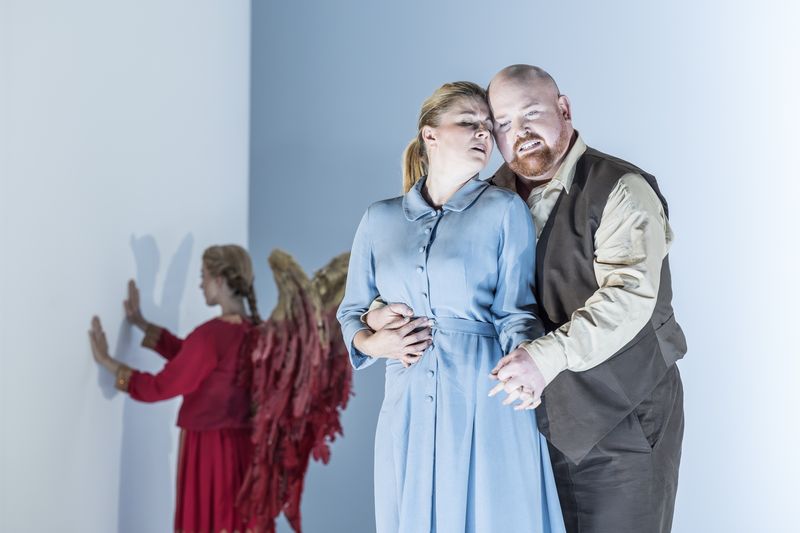
© Glyndebourne Productions Ltd. Photo: Marc Brenner
The strikingly powerful tenor Nicky Spence has impact from his very first moment as Boris Grigorjevič. Bell like clarity and impressive passion marking this as a fine dramatic and operatic performance.
Marfa Ignatěvna Kabanová (Kabanicha) is delivered with powerful venom and spite by Susan Bickley, spitting out her reproaches of Káťa with dramatic skill but never losing the essential musicality of the score.
In truth the singing and acting on display here certainly measured up to one’s expectations of a Glyndebourne production. And the London Philharmonic Orchestra under Robin
Ticciati deliver a luscious rendering of Leoš Janáček’s wonderful writing. There are moments when one hopes that some of the beautiful moments of his composition were further developed by him, but it is what it is.
Musically this is a stunning production, but one perhaps hindered by the overthinking and presenting Káťa’s state of mind in visual conceits that at times bordered on patronising. The presence of that angel, delivered with haunting presence by Miryam Tomé, falling feathers, that boulder and the final chaos of those falling cages, a moment diluted by the online presence of the making of that moment, all in all clouding rather than enhancing the work.
Forgive my misquotation (or misspelling) of a passage from Corinthians – “If I speak in the tongues of men or of angels, but do not have love, I am only a resounding gong or a clanging symbol”.
Andrew Kay
6 August
[rating: 3.5/5]