








BREMF – Out of the Deep – Vache Baroque
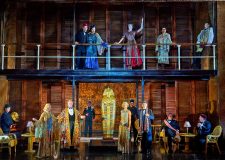
Well, what has Oscar Wilde got to do with early music? It’s complicated but it does make sense. A major part of the BREMF mission is to broaden its education and outreach programmes. Vache Baroque not only takes its art around schools but also into other institutions, in this case prisons. Oscar Wilde wrote a soul-searching letter from gaol that is a most poignant testimony of the spirit of an artist in prison. It was later entitled ‘De Profundis’, after the penitential psalm 130, ‘Out of the Deep’. Excerpts of this were narrated between each musical item by Malcolm Sinclair with a convincing repertoire of Wildean emotion. There was also a sound installation and art exhibition by associated members of the prison community.
Vache Baroque has compiled a sumptuous programme that relates to this theme. The musicians had taken their places; the singers were sitting silent behind them; the audience had settled and after a long pause the precise violin of Sophia Prodanova picked out the opening strains of Peter Philips’ Galliard Dolorosa. This served as a fitting overture for the whole concert as it expressed Philips’ feelings in a foreign prison, awaiting trial for plotting against Queen Elizabeth I’s life. Unlike Wilde, Philips talked his way to freedom.
After the first Wilde passage came John Wilbye’s sprightly madrigal Ye that do live in pleasures plenty which is about reclaiming a lost reputation by means of song. The singers expressed this joy and optimism most charmingly. Love too has a magical restorative effect according to Purcell’s Sweeter than roses, sung with passion up close to the audience by countertenor Alex Potter. After another reading the whole ensemble came in with Purcell’s powerful anthem Jehova, quam multi sunt hastes mei, that featured strong solos from tenor Guy Cutting, baritone Jolyon Loy and bass-baritone Will Harmer.
The readings from Wilde were now more intense. Guy Cutting took us into even darker territory with his stylish performance of Purcell’s In the black dismal dungeon of despair, which was very moving indeed. The first half of the evening concluded with Jan Dismas Zelenka’s dramatic setting of the psalm De Profundis that opens with no less than three bass voices. It was very impressive, a real showcase for this fine ensemble.
The concert resumed not with Wilde but with a section of Richard Lovelace’s poem To Althea, from Prison that contains the immortal words ‘Stone Walls do not a Prison make’, so very much part of the theme of the evening.
The strophic chorale Mein G’mueth is mir verwirret by Hans Leo Hassler, with the same tune as Bach’s Passion Chorale, begins with the line translated as ‘I’m all mixed up’ and it resolves in divine redemption. It made for meditative listening, especially in the serene solo verse given by soprano Mariana Rodrigues who has had a very busy week at BREMF.
We were then treated to Bach proper, BWV 131, Aus der Tiefen rufe ich, Herr, zu dir, sung in separate movements as the readings from Wilde got even more anguished, climaxing in his poem Desespoir (despair). The cantata allowed for more rapturous solo arias and here it is appropriate to commend the exquisite orchestra, all of whom were soloists, especially the sterling continuo players: Jacob Garside, Toby Carr and Makoto James.
We heard the same Hassler tune again in the conductor of Vache Baroque Jonathan Darbourne’s arrangement for bass voices of Brahms’ Chorale Prelude on Herzlich tut mich verlangen. This was beautifully sombre and led into the final Wilde reading, his redemptive bedtime story for children, The Selfish Giant. He dies happy in the end and the whole company broke into the sumptuous Requiem Æternam, the majestic last movement of André Campra’s 1723 setting of De profundis, which could then have concluded the theme. However, these generous performers had an encore, the very final polyphonic jewel In pace by John Sheppard: ‘In peace, true peace shall I sleep and rest’, the solemn voice of Jolyon Loy ending this spectacular concert with haunting, austere plainchant.
Andrew Connal
St Martin’s Church,
24 October 2025
Rating:
Vache Baroque
Jonathan Darbourne conductor
Malcolm Sinclair narrator
Betty Makharinsky soprano
Alex Potter countertenor
Guy Cutting tenor
Jolyon Loy baritone
Jasmine Flicker soprano
Peter di Toro tenor
David Le Prevost baritone
2025 James Bowman Young Artists:
Mariana Rodrigues soprano
Laura Toomey alto
Alexander Semple baritone
William Harmer bass-baritone
Sophia Prodanova leader, violin
Kate Fawcett viola
Felicia Graf viola
Jacob Garside viola da gamba, cello
Carina Cosgrave double bass
Oonagh Lee oboe, recorder
Joel Raymond oboe, recorder
Toby Carr theorbo
Makoto James organ
Dan Samsa sound installation designer
Programme:
Peter Philips c.1560-1628 – Galliard Dolorosa (composed in prison, 1593)
Oscar Wilde 1854-1900 Reading: from De Profundis (written in prison, 1897)
John Wilbye 1574-1638 – Ye that do live in pleasures plenty (1598)
Wilde Reading: from De Profundis
Henry Purcell 1659-1695 – Sweeter than roses (1695)
Wilde Reading: from De Profundis
Purcell – Jehova, quam multi sunt hostes mei (c.1680)
Wilde Reading: personal letter to Bosie Douglas
Purcell – In the black dismal dungeon of despair (1688)
Wilde Reading: from De Profundis
Jan Dismas Zelenka 1679-1745 De Profundis (1724) 1st movement
Wilde Reading: from De Profundis
Zelenka De Profundis (1724) 2nd & 3rd movements
Wilde Reading: from De Profundis
Zelenka – De Profundis (1724) 4th movement, Doxology
Richard Lovelace 1617-1657 – from To Althea, from Prison (1642)
Hans Leo Hassler 1564-1612 – Mein G’mueth is mir verwirret (1601)
Wilde Reading: from De Profundis
Johann Sebastian Bach 1685-1750 – Aus der Tiefen rufe ich, Herr, zu dir (1721) 1st & 2nd movements
Wilde Reading: from De Profundis
Bach – Aus der Tiefen rufe ich, Herr, zu dir (1721) 3rd, 4th & 5th movements
Wilde Reading: Desespoir
Johannes Brahms 1833-1897 arr Jonathan Darbourne – Herzlich tut mich verlangen (1897)
Wilde Reading: The Selfish Giant
Andre Campra 1660-1744 – De profundis (1723) Requiem Aeternam